One of the joys of living in a remote Greek village is the occasional visit by travelling entertainers and travelling salesman. I have seen tragic actors reciting Lystrata and not understood a word. I followed the speeches by watching the faces of formidable, traditionally dressed women as they nodded and grimaced at the ancient words excoriating men in general, and by implication their husbands in particular.
In the same forum, a small square by the sea, I have seen actors in over acted farces struggle to raise a laugh from the same women, supposedly shocked by rude words and the exposure of shapely legs and frilly knickers.
In addition to these visitors we regularly welcome a variety of travelling salesman. Men arrive to mend tattered rush chairs while their families sell new ones manufactured we know not where. Fruit sellers set up under the trees next to the sea. We don’t know where they come from. Perhaps the North; Albania, Bulgaria or Kosovo? Maybe they are gypsies, it is hard to tell. Could they be from India? They don’t speak much, but when they do it is difficult to follow their Greek. If it is Greek. Some drive round the village broadcasting their wares: the muffled sound of loudspeakers echo round the scruffy alleyways, luring hard up locals out of their dark houses to stand in a queue, picking out the best bananas or the ripest watermelon. One family are basket makers. They need a little more space and sit at distance from the kafeneion. The father of the group is a skilled craftsman. He sits on a kerbstone, grips the basket between his toes and turns it round while weaving a long withy in and out of the basket base. He makes baskets to order: tell him the size, chose a withy of your preferred colour and an hour later you have a work of art and he has a handful of euros.
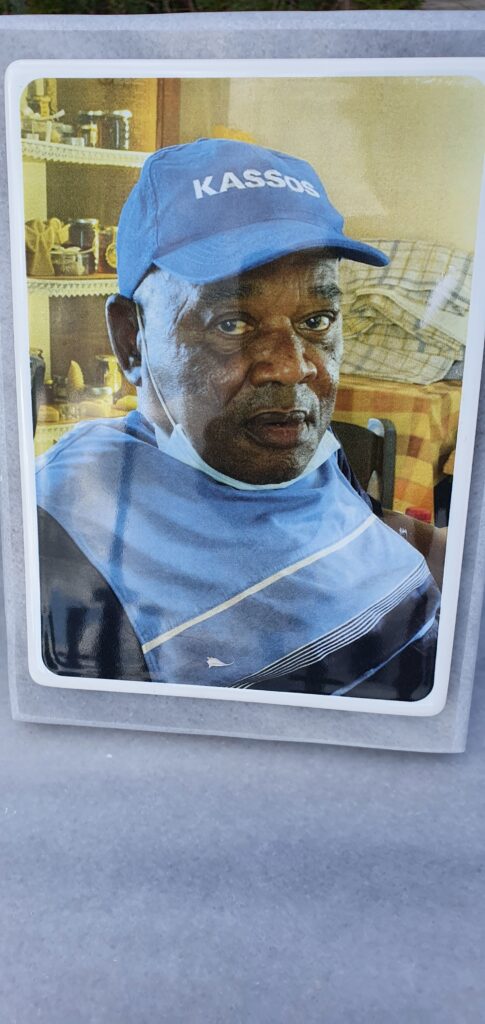
One, long time, regular visitor was Victor, a man from the Congo. How this chubby faced, quiet and sad man ended up travelling around the Dodecanese on Blue Star ferries is a mystery. One day, he just arrived, walked around the harbour carrying two laundry bags, stopped at the kafeneion and unloaded a cornucopia of Chinese knick knacks; battery driven cuckoo clocks, garish gold framed pictures of Japanese gardens, and cheap frying pans; an arcane collection of trashy goods with little use and no artistic value. And of course the locals loved them. There was a hint of the outside world come down to Diafani, the chance to joke with someone less fortunate than themselves and an innocent stranger with whom to bargain. Pride would drive the villagers to go back and forth for hour after hour with a slightly improved offer until a bargain was struck. Then someone would buy Victor a coffee or offer a sandwich or a free meal at the Rahati or the Blue. When the ferry boat returned he was off again, returning a month or two later, driven by his own timetable. Thus Victor became a fixture in the the village calendar until one day someone asked where is Victor? And we realised we had not seen him for a while. South from Karpathos is the small mountainous island of Kassos. It is a quiet and gentle place with several small villages and a charming port. Kassos has a heroic history, the population are great engineers and the Kassiotis are famous for building the Suez Canal. The people there are similar to us, but less competitive and more content. They too had been visited by Victor over the years. They too had been affected by his soft smile and sad face. So they asked more questions and found he was the father of several children and any money he made was sent back to them in the Congo. Now he awaited burial in an unmarked pauper’s grave in Athens, something which offended the kind Kassiotes. They collected money for their gentle visitor, and had his body moved to Kassos where they conducted a Greek Orthodox Christian burial. There he lies in a marked grave with marble furniture more luxuriant then anything he experienced in life.
This could be the end of a bucolic, luxuriant story, but it has a darker side. I asked around to find how Victor had fallen into his lifestyle. I was told, in simple terms, it was the Mafia. They arrange for people like Victor to have some kind of papers legalising their stay in Greece. They provide the sacks of gaudy goods and they tell their clients to return in four weeks time with so many euros to pick up more of the same. If they don’t have the money they will be brutalised and turned over to the authorities for deporting. It explains a lot. The sad face, the gentle smile, the passivity was that of a man crushed by the system. There are hundreds of Victors in Greece, maybe thousands and tens of thousands in Europe. Perhaps you have come across the mysterious expression, Modern Day Slavery, in official documents and wondered what it means. Well now you know.
Leave a Reply