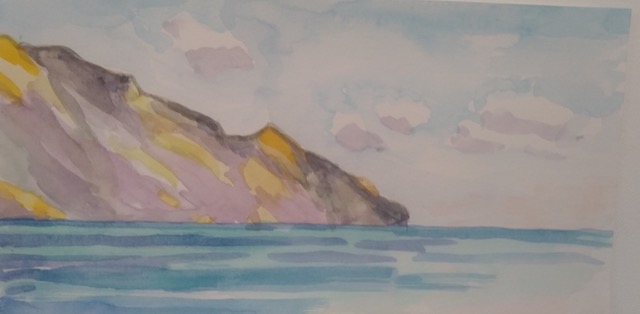
The migration is well under way with bee eaters, little bitterns,wagtails, eleanora’s, a booted eagle and a lanner falcon(?). Everything is very green and there are herbs and flowers everywhere.
Blog
-
Bonelli’s Eagle (Hieraaetus fasciatus)
Georgos works these days as a guard for the wildlife and landscape of Northern Karpathos and Saria. Sometimes I help in this work and I also keep an eye on Bonnelli eagles for the Hellenic Ornithological Society. I am proud to bear the honorific title Keeper of Saria. There are 600 breeding pairs of Bonnelli in Europe and I estimate we have four on the island. I have been watching one pair for three years now. I recognise them, they recognise me. The male has several feathers missing from the trailing edge of one wing. They do not soar, but course their large territory in straight lines looking for rats and mice, snakes and small goats. Sometimes they ambush doves and gulls. They are wonderful birds.
Last autumn we were up on the plateau of Avlona. It had rained and we were looking for birds and picking snails from the dripping plants (snail pilaff is wonderful). The sky was clear but after ten or fifteen minutes looking up and around I noticed movement on the ground thirty metres away on a low hill. Four ravens were gathered round something large on the ground. I thought it a dead animal, but it was something alive, something red and brown, exactly the same colour as the damp earth. As I focused I saw it was a young Bonelli being teased by the ravens. They got too close and suddenly it reared up with open wings. Ravens are big birds with a wingspan over a metre, but Bonelli’s are bigger. Even this young bird was half as big again as the ravens. They pulled back, hopped away and tried to look disinterested. The Bonelli hopped and bounced and took off to complete a circle of the hill before it settled again a little further away.
I have been back several times to the same place, but never seen this bird again. I suspect it moved away looking for a mate. The parents have moved nearer Vragounda where they are disputing territory with Long Legged buzzards Buteo Rufinus. I don’t know why they moved. Perhaps it is not my business.
-
Eleanora’s Falcons
One of the joys of living in the village is the bird life. I have written about Eleanora’s Falcons elsewhere, but I know them more intimately now. They are used to me chugging along in my little boat and know that I am harmless, so ignore me. These birds are surely the best flyers. Effortlessly they swoop, rise and fall using the wind as it tumbles down the cliffs and billows up again as it hits the sea. The display can be seen any evening from spring to autumn as the birds return to roost, but twice a year something special happens:
In the springtime the birds pair off and the females seem to chose their mate on flying ability. Two dots high on a cliff suddenly become a pair of Eleanora’s, one a few centimetres behind the other as they level out and skim the waves at high speed. The male flies so close to the surface that on a calm day I see dimples in the water caused by air pressure from the wings. Off and up goes the female untill, caught by the male, the pair join feet and with much squeaking and shrieking spin back down to the sea. I do not know if others have seen this behaviour. It was many years among these birds before I recognised what was happening one evening and sat in awe in a calm sea watching and listening to the lovemaking. As it became cold and dark I made my way slowly back to the village followed by the faint sound of Eleanora’s having fun above the cliffs in the pale golden embers of dusk.
Later in the year the parents teach the young to fly. Solitary, or in groups of up to a dozen, they plunge down the cliff face, caress the sea and climb up and over again with cries of excitement and joy. Again in pairs, but this time parent and child, they slide over the surface as the adult forces its young closer to the water, sometimes leaving a dappled ring as a feather, wing tip or claw touches the sea.
This complicated, learnt behaviour is essential to the Eleanora’s survival. In late summer, and autumn, as the young are born and grow, their main food source is the small migrating birds making their way south to Africa. These little birds leave Rhodes and Chalki and the other islands to the north of us in the morning and arrive on this island in the evening or at night. Eleanora’s form a net several kilometres out to sea and wait for the food to arrive. When they see the little birds they swoop to attack. Sometimes I see an explosion of feathers and a forlorn wisp of plumage flutters to the sea. The little birds defence is to fly as close to the sea as they can, zig zagging in terror, desperate to make the first rocks of the coast. Thus the Eleanora that flies close to the sea with greatest skill is that one that eats well and brings home the most supper; a worthy mate and parent.
-
Balakas
Many migrants live in the village; Albanians, Egyptians, Rumanians, an Italian and of course me. Mostly they are young men and they find work as builders or carpenters. Some of them are highly skilled. There are two Africans in the village; tall, young, slim and very black. They are refugees from Senegal, sad to be away from home, but glad to have work even in this strange place. Such people arrive in Europe often after long and dangerous journeys. Newspapers are full of compassion when they show us the dead bodies washed up on a beach in the Canary Islands, Malta or Southern Italy, but they just want to sell papers so they do not tell the full story. For centuries West Africa had a thriving fishing industry, sustainable and employing many local, skilled young men who went out daily in their pirogues, drove through the surf and fished with long lines and nets. They sold fish in local markets, they salted fish and sold salt fish regionally. It was dangerous, hard work, but they made a living. This was a local indigenous industry, employing thousands and feeding tens of thousands. Then the fish ran out. Not in Africa, but in Europe and Japan. Governments did what governments do. They avoided the truth. They hid behind the belief that the seas are abundant, a limitless resource. They did not seek to preserve fish stocks at home, instead they subsidised the large companies to build large and supposedly efficient ships to use the latest technology and catch fish in other parts of the world. For a few hundred thousand euros into discrete bank accounts, permission was granted for these factory ships to exploit the seas of West Africa. Soon the local population saw these large boats off the coast; fishing and dredging day in and day out; destroying the sea, the sea bed, the local environment and the local economy. The ships provided no work for the local people, they just took away their fish. The destruction was as cruel and massive as the clear cutting of rain forests. A crime against the environment by the haves for the haves, paid for by the have-nots. Soon the fish ran out and most of the ships moved on, leaving behind an unemployed and resentful population with boats and the courage and skills to drive them across the seas. Now the sea brings a new harvest; young black men who end dead up on the shore or are taken in to the underworld of crime and drugs and prostitution and money going into the same discrete bank accounts. In different ways the scenario is repeated across the world. A problem that will not go away and which has no solution under the current economic and political structure.
Here in Greece the government seeks to alleviate the pressure on Athens by dispersing refugees away from the capital and subsidises villages who take them to do work in the local community. Dinos the mayor arranged for the Senegalese to come and stay. They are so tall and athletic I wondered if they were part of our new basketball team. This turned out to be prescient. They are good footballers and should be in the village team, but there was a major row with the other villages on the island who insisted that the ‘one foreign player only’ rule should apply. They look the same so they take it in turns.
One of the Senegalese, Moustapha has become my friend. He has impossibly long, flexible limbs, like the young Muhammad Ali. He laughs a lot. Wearing a tattered baseball cap pulled low he has a wondrous smile, but only occasionally shows his dark, intelligent eyes. Moustapha speaks his tribal language, Wolof, as well as French and a little English. I am teaching him Greek. How many Senegalese speak Greek?
Moustapha is a sensitive man, but rather shy and finds it difficult being one of only two black people in the village.
All eyes are on me, he says. The only black man in the cafeneion.
He makes jokes about these things but, if you listen, you can hear the pain.
I am black, I am malakas. So I am balakas.
Moustapha can be very funny and also perceptive. We meet for a coffee in the morning at Gabriella’s. One time she arrived late, obviously in a bad mood.
Gabi is sad, Moustapha said softly.
Problem with the heart. He paused.
Problem with the head.
Then a longer, delicious pause.
Problem with the body.
And he laughed his sad melancholic laugh. An African man far from home. A black man, but not balakas.
-
Vananda
North of the village at the bay of Vananda there are two chapels. The furthest one is quite new, barely two decades old. At the back, on a platform is a round, black water tank. On the tank is written in clear Greek capitals;
Governments fall, but Vananda goes on.
A comforting thought.
-
Spring Opening
Gradually and belatedly the village is coming to life. Winter was hard with many storms, but not a great deal of rain. Now, in early May we have had two days downpour leading us to believe that water will last through the summer months. Everything is green and cool and there is hope for a good harvest of honey this year.
There are no more than a handful of tourists, but signs are appearing outside hotels and restaurants.
PRIVATE ROOMS with BAT is my favorite. Iannis is clearly going for a niche market.
Gabriellas’s new sign announces
GREAT ATMOSPERE
which has led to a number of comments. Last year she announced
INTERESTING PEOPLE INSIDE
prompting anger from Papa Minas who demanded to know what kind of people we had outside. There was some suggestion that he put up a sign outside his church
EVEN MORE INTERESTING PEOPLE INSIDE
But it came to nothing.
The bird arrivals have been interesting; swallows, crag martins, hoopoes, black winged stilts (a first for me), long legged buzzards, many varieties of yellow bird, which keep together in flocks and a lone, first eleanora.
-
Rembetika
For more than a week the weather has been strange and calm without wind. In the evening the sea is the colour of mercury. Two days ago I went fishing for palamida (small tuna). The system is to travel far out to deep water then slowly trawl a line with feathers and hidden hooks that resemble small squid. If you come across a shoal of palamida it is possible to catch several at a time. On a line with 13 hooks Georgos once caught 12 fish. Getting them into the boat without snaring yourself or making a birds nest of the line requires a lot of skill.
There were low lying clouds and alone in a small boat on a flat sea a long way from land I became paranoid. I kept looking around as if something was there and suddenly there was. A low, dark line in the water stretched out like an oily rope around 20 meters long. It could have been a huge sea snake, a sea monster, basking shark or whale. I was uneasy, but fortunately I have seen such a thing before and knew it to be a pod of lazy dolphins resting their nose on the tail of the one in front. The first one steers while the one at the back swims. The others sleep, or read a paperback, or whatever dolphins do when they are taking it easy. But it was a strange feeling and I did not go too close. Just in case. With dolphins around there would be no palamida so I made the long journey home. That night I ate pasta.
The next night I tried again, this time trawling a lure close to the coast, fishing for barracuda. I was lucky and caught a fair sized fish. Enough for two or three of us. As the light faded, clouds gathered and reflected pink on the silver sea and we sat quietly in the Rahati while Elias grilled the fish. A parea developed. Four or five of us with beers and retsina and meze and then the fish. By the time it was dark we were joined by Iannis, a coastguard with an earring (!) New to the village he fits in well. Serious about his work and serious about his fun he is an accomplished musician, playing the bouzouki and singing Rembetika songs. One of the parea was Memo, a fine name for a nostalgic old man. Soon there was talk of the masters of this music, sometimes called the Greek blues, then there were songs of hashish and poverty, exile and loss written or recorded by Vamvakari and Tsitsanis, Papayoannou and Dalaras. Both Iannis and Memo have good voices and the songs rang out as the bottles clinked and the tears flowed. Any Greek glendi has a gamut of feelings and we were taken on a roller coaster of tears and laughter, love and hate, peace and revenge.
By midnight I had drunk enough and I found my way home to the sound of 1920’s Smyrna. Storm clouds had gathered and there was spectacular thunder and lightening, though very little rain. Of course the electricity shut down, but at Rahati, lit by candles and imagination the party continued until dawn. All this was unplanned and spontaneous. Strangely as I picked my way through the wreckage of the morning I discovered there had been a party at the other end of the village. Gabriella, Andoni and Michaeli combining to host another glendi until dawn. Perhaps it was the weather.
And now it is raining and I learn, once again, that a litre of retsina for a man of my age is far too much.
-
Its not all Fun and Games
From the InKarpathos web site. November 18th 2008
Today an Egyptian drowned in Saria. From first reports, the Egyptian was working on a fishing boat and at around 5am, they told him to do something, but he was nowhere to be found. The body was found at around 11:00 am and was brought to Pigadia. A witness at the harbor stated that there was blood coming out of his ear and mouth.
-
Sometimes Things Work Out
Drinking my morning lifesaver (cafe latte ) in Gabriella’s, I watch Kosmas sitting quietly in the corner writing mantinades. I start to think about lunch. That’s how tough it is here.
Along comes Georgos’ mother. She has a bowl of patsas for me. I will spare the squeamish, but for the anatomically minded try googling p a t s a s.
Forget the eggs she says, just heat it up and eat with good bread and a squeeze of lemon.
I set off homeward with my bowl, wondering where I can get bread and whether it is worth climbing to the top of the hill to pick lemons. It is windy and as I turn down the little lane on the way to my house I see a a lemon rolling towards me. Small but juicy and perfect.
I pocket the lemon.
Suddenly Vassillis from the Anixis starts shouting.
Ella dw ella dw
Come here. Come here.
When Vassilis shouts, you listen. So I go close.
Take this bread, he tells me
Artos, from the church. There was a festival this morning.
I laugh
Why are you laughing? he asks
I tell him of the patsas and the search for lemon and bread.
O theos enai megalos. I tell him.
And surely it is true, he tells me
God is great.
-
Africa in Diafani
We have another new bar on the beach next to Ilias’ lovely bar. It is run by women. The eldest sister sings rembetika very well. She is professional. Then there is Maria who has opened an ouzeria next to Gabriella. In Michaelis his daughter Evangaleia is coming to the fore. A monstrous regiment of bar kepers
Last night we had music in Michaelis.
A Brazillian rastafarian, Fabbio playing cymbals, Christo on guitar, Evangelia and Michalis on lyra, Michalis singing and Georgos on lute. Brazillian /Diafani reggae fusion. At the end of one song where Georgos had been pounding away, keeping up an amazing rhythm Fabbio leapt up and pointed at Georgos
Africa he shouted, Africa.
He was right. African in a small Greek village. Can’t be bad.